The expedition
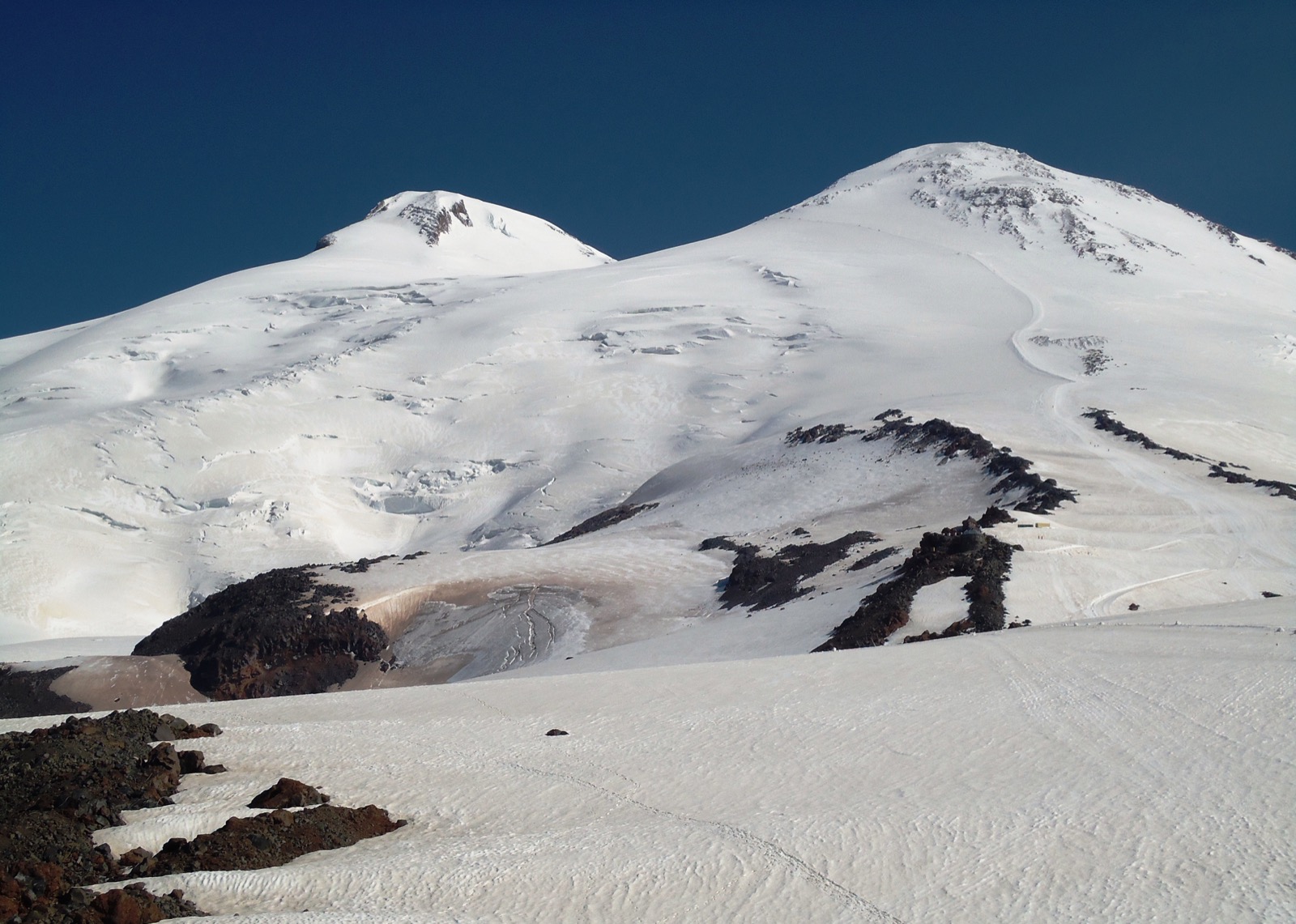
The idea was Alexander Abramov's, a Moscow climber who later founded the 7 Summits Club. In June 1996 the Land Rover and BMW dealer Avtodom, whose director Andrei Kostin took the project on, asked the off-road driver Oleg Bogdanov to run the motoring side; Channel One television and the Risk company were the other initiators and the outdoor firm Alpindustria among the supporters. Bogdanov walked the route with Abramov and his wife Lyudmila that summer, from the end of the road at 2,200 m past the Barrels huts at 3,800 m, the Priyut 11 hotel at 4,200 m, the Pastukhov Rocks at 4,800 m and the saddle at 5,300 m, and concluded that the climb was possible for a turbodiesel with winches, but that the people would suffer more than the car.
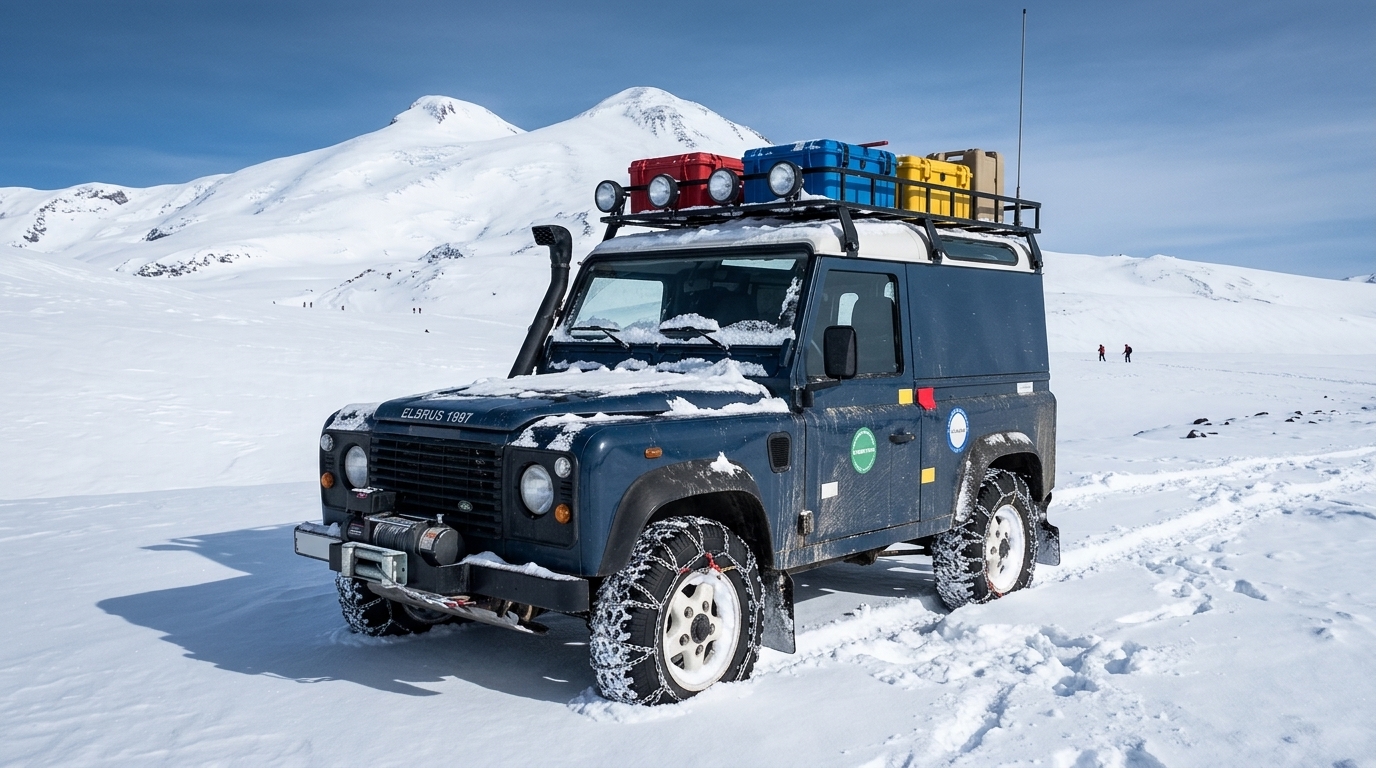
The vehicle was a Defender 90 with the 113-hp turbodiesel, prepared to the team's specification by Mantec Services in Coventry: heated fuel system, two eight-tonne Superwinch winches front and rear, air-locking differentials, engine and transmission guards, radio, an expedition roof rack and lights for night work, several sets of tyres, titanium chains and purpose-made spiked plates like climbers' crampons. Ready for the mountain it weighed 2,100 kg. A trial ascent in the autumn of 1996 broke both front driveshafts in deep snow at 3,400 m; over the winter the Bauman Institute in Moscow analysed the failures and Mantec made strengthened driveshafts and half-shafts. The team of ten, with Abramov as leader, arrived in the Elbrus area in August 1997.
The assault began at 6.30 a.m. on 1 August 1997 from the Khizhina-Logovo hotel at 2,300 m, where the asphalt ends. The old rock road took the car to 3,500 m in a day; on the second day a rear half-shaft broke and the front winch burned out. On 3 August the Defender reached the Barrels at 3,800 m and the permanent snow. From there the team worked at night and in the early morning when the snow froze hard, and on one cold morning Nikolai Nikulshin drove up to Priyut 11 at 4,200 m without the winch. Above that nobody had ever taken a motor vehicle. An unusually warm summer turned the snow to slush; the car went on chains and spiked plates where it could, and where it could not the team drilled the snow with a hand auger, set aluminium tube anchors and winched — and when the winches failed, they bolted spare wheel rims to the front hubs as capstans and wound the car uphill on its own spinning wheels, a trick Bogdanov had learned as a driver for geological survey parties. There were nine serious breakages in all: wiring burned out, the steering box seized, a track-rod end broke, the transfer box shattered. Parts were fetched from the valley, sometimes by paraglider to speed the descent, and men fell into crevasses. On the 44th day, after two days of blizzard spent in a tent and a snow cave at the 5,300 m saddle, the final push began, and at 8 p.m. on 13 September 1997 the Defender rolled over the lip of the eastern summit at 5,621 m. Eight people were with it: the climbers Konstantin Bruskov, Alexander Koval, Alexander Kopylov and Andrei Leontiev (who had replaced the injured Vasily Elagin), the drivers Bogdanov and Nikulshin, and Avtodom's Sergei Babenkov.
No helicopter and pilot could be found to lift 2.5 tonnes off the summit, so in October the team went back up to drive it down. Bogdanov carried a car battery to the summit to start the frozen engine. On 11 October the party spent a last night in the car on the 40-degree slope below the summit; the next day Nikulshin sent his 16-year-old son out of the cab, started the engine, and the steel rope holding the car parted. He braked to the last moment and jumped clear as the Defender gathered speed, fell several hundred metres and was wrecked on the rocks at about 5,400–5,500 m, where it remains. Everyone came home alive. The ascent entered the Guinness Book of Records as the highest climb by automobile, and the film Man, Car, Mountain won the Vertical festival of adventure films. In 2008, for Land Rover's 60th anniversary, the participants announced a project to bring the wreck down, with reconnaissance led by Alexander Koval; the pieces are still there.