The expedition
Mark Owens and Delia Dykes met in a protozoology class at the University of Georgia, married on 31 December 1972 and decided to study a large African carnivore somewhere no one had worked before. They had almost no money: they took whatever jobs they could find, sold their possessions, including the car, for $1,100, and on 4 January 1974 — a year after their wedding — boarded a plane for Africa. The book opens with a grimy sign under a dim yellow light reading GABORONE BOTSWANA and a sagging hotel with flaking paint. From the beginnings of a third-hand Land Rover, a campfire and a valley called 'Deception', as they put it, everything else followed.
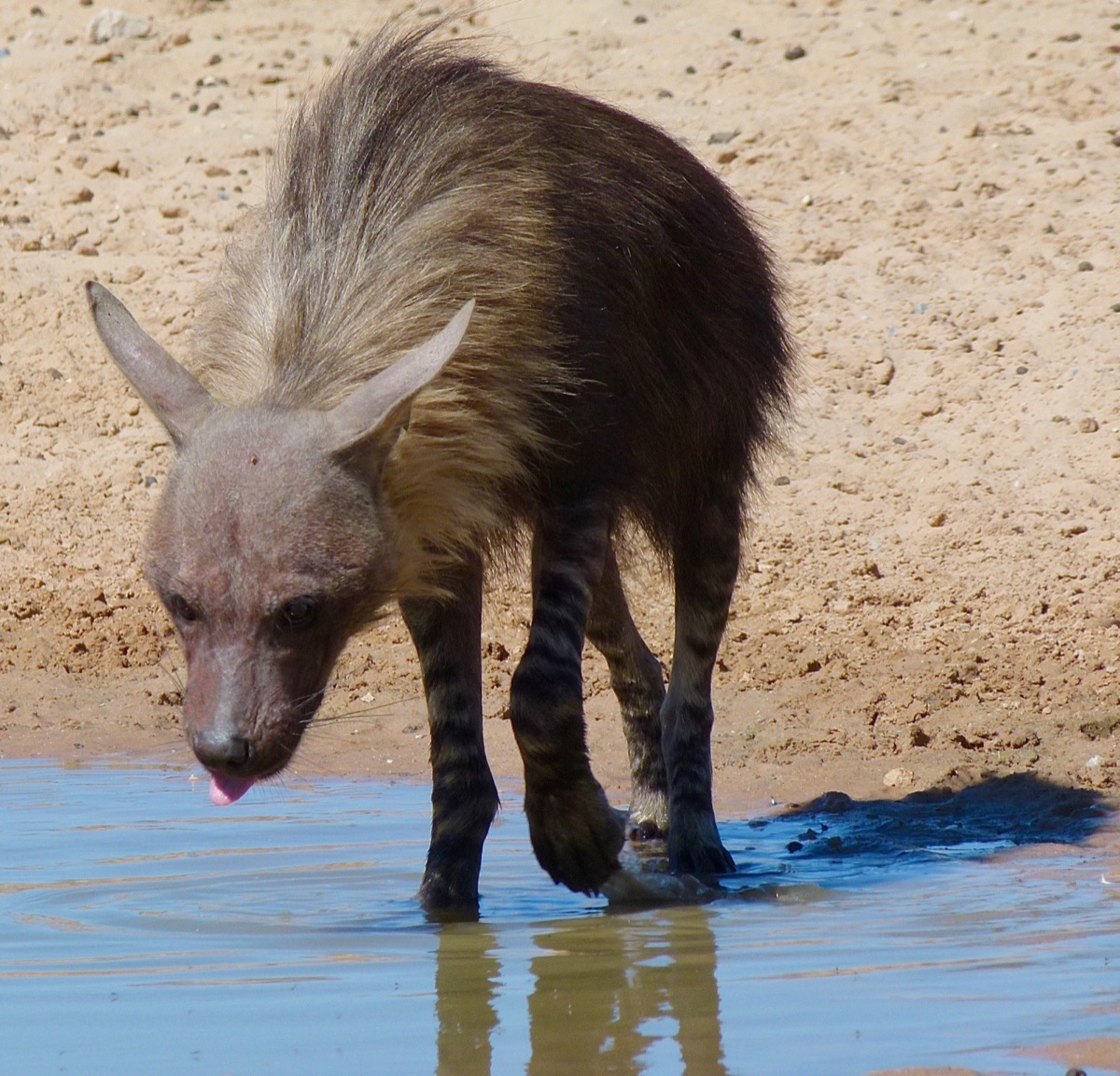
A pilot in Maun suggested the Kalahari — he had seen a place called Deception Valley from the air with plenty of game — and in late April 1974 they set out from Maun in the Land Rover to find it, navigating across trackless sand with a resolve not to return without having found the valley, and a rule that if it had not appeared within another twenty miles they would have to turn back while the fuel lasted. Deception Valley is one of four fossil river valleys that wind through the 52,800 km² Central Kalahari Game Reserve, established in 1961 and then almost entirely unvisited; Maun, the nearest town, was about a hundred miles away and eight hours' driving, and the animals had never seen people. The couple camped in the riverbed under an island of acacias. Within days they had seen an animal that was too small for a spotted hyena, too large for an aardwolf and in the wrong range for a striped hyena, and decided it could only be Hyaena brunnea, the brown hyena, a species about which almost nothing was known in the wild; sitting on the roof of the Land Rover in the moonlight they decided that if they stayed longer they might find out whether a brown hyena study was possible. It became their flagship species, and with the Kalahari lions the subject of seven years' work.
The early years were a struggle for supplies as much as science: the Land Rover — Delia following in it while Mark felt for firm ground barefoot, dodging ruts three or four feet deep — was their only link to Maun, and the book records floods in the wet season, long droughts, bush fires sweeping thousands of square miles, and heat that pushed the work into the cool hours. A grant from the Okavango Wildlife Society, whose director Hans Veit sought them out in Maun, was their first outside money and paid for equipment; later support let them buy a ten-year-old blue-and-white tail-dragger Cessna, registration EWG, 'Echo Whisky Golf', to follow the lions and the wildebeest from the air. The research was published in the African Journal of Ecology (1978), the Journal of Mammalogy (1979), Natural History (1980) and Nature (1984), and the Kalahari Research Project earned them a Rolex Award for Enterprise in 1981. Named animals — the lion 'Bones', whom Mark treated for a broken leg, the brown hyena clan of Deception Valley — carried the story.
The project also made the couple unwelcome. They documented the veterinary cordon fences built to control foot-and-mouth disease, which cut off the wildebeest migration to water and starved the herds by the tens of thousands, and hunting and poaching that exceeded the legal quotas; the appendices to their book set out conservation measures for the migratory ungulates, the lions and the brown hyena. After they campaigned against the cattle industry's fences the Botswana government expelled them, and the book's last chapters record their final morning in Deception Valley. 'Cry of the Kalahari' (Houghton Mifflin, 1984) won the John Burroughs Medal in 1985, was translated into seven languages and became a national and international bestseller; the couple moved on to North Luangwa in Zambia in 1985, where their later books 'The Eye of the Elephant' and 'Secrets of the Savanna' pick up the story. Delia Owens' novel 'Where the Crawdads Sing' (2018) brought the Kalahari memoir a new readership. The Land Rover's make and fate are not recorded in the sources fetched.
_(50915393781).jpg)