The expedition
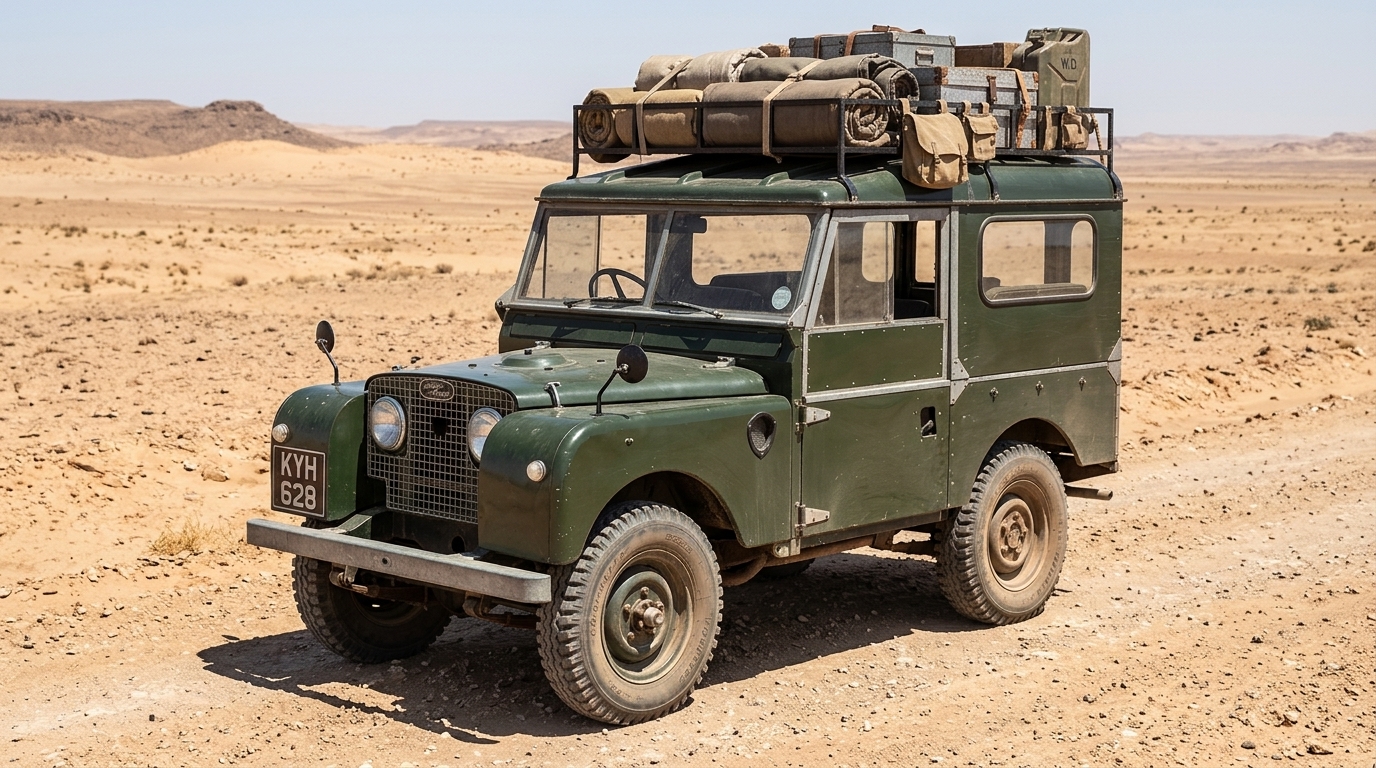
After her 1951 drive from Tangier to Baghdad, Barbara Toy had Pollyanna, the second-hand 1950 Series I 80-inch she had bought from Henlys for £640, fitted with a new station-wagon body in place of its canvas tilt, the flat roof painted white to reflect the sun. Then she and the car sailed for Tripoli. The journey that followed took six or seven months of 1952 — the book's jacket says seven, the Reuters report of her return six — in the Kingdom of Libya, independent for less than a year and still living with the desert war's dead and debris.
She drove the coast road through Tripolitania and Cyrenaica and made two long excursions inland. The first was south into the Fezzan to the oasis of Traghen. The second, and the harder, was to Kufra: to Al Jawf, which she called El Giof, and to El Tag, the Senussi settlement above it, with a guide who was the same man who had led Rosita Forbes to Kufra in 1920–21, when it was still closed to Europeans. On the coast she met Major Gordon Lett, who at the second fall of Tobruk had ordered vehicles pushed over the cliffs into the sea rather than leave them to the Germans, and she spent time in the desert with Herman Schultze-Dewitz, once Rommel's ADC and now running the German War Graves Commission's unit in Cyrenaica, searching for the dead. At Benghazi she went diving with Greek divers in the harbour; her suit sprang a leak and she was hauled up in time, and three weeks later the sunken ammunition ship she had been diving beside blew up. She carried a large hammer rather than a gun, she told reporters, because she was not an awfully good shot, and wore lipstick 'for morale'.
She arrived back in Britain by ship at Dundee on 17 October 1952, after what Reuters called an 11,000-mile journey across the Libyan desert in a light truck, seeking material for a book. That book, A Fool in the Desert: Journeys in Libya, was published by John Murray in 1956, 180 pages, the second of the four written around Pollyanna; the third journey, across Saudi Arabia, followed in 1953 and the round-the-world drive in 1956–57. Pollyanna, KYH 628, survives: given up to Rover in about 1960 after 210,000 miles, passed to a Chesterfield technical college, restored by an enthusiast and bought back by Toy in 1989, it took her round the world a second time in 1990 at the age of 81 and is modelled in this registry.
.jpg)
